

Stretches for Lower Back Pain You Can Do at Home
Five gentle stretches for lower back pain you can do at home, with step-by-step instructions, safety red flags, daily habits that protect your back and signs it is time to see a chiropractor in Bartlett, TN.
The best stretches for lower back pain are gentle, slow movements that ease tight muscles and restore motion without forcing the spine: knee-to-chest, cat-cow, the piriformis stretch, child's pose and the pelvic tilt. Done for a few minutes once or twice a day, they may loosen stiffness and calm muscle guarding. For many people in Bartlett, TN, a short home routine is a practical first step before an everyday ache becomes a long-term problem.
Why Does Lower Back Pain Happen?
Your lower back, or lumbar spine, supports most of your upper body weight and takes part in almost every bend, lift and twist you make during the day. That constant workload is why it is one of the most common places people feel pain. The National Institute of Arthritis and Musculoskeletal and Skin Diseases explains that most back pain is mechanical, meaning it comes from the muscles, joints, ligaments and discs rather than from a serious disease.
Common contributors include:
- Long hours sitting at a desk, in the car or on the couch
- Tight hamstrings, hip flexors and glute muscles that pull on the pelvis
- A weak core that leaves the lumbar spine doing extra work
- Lifting with a rounded back or twisting while carrying weight
- Age-related changes in the discs and small spinal joints
Stretching helps because tight tissue around the hips and pelvis often adds strain to the lower back. When those muscles relax and joints move more freely, the load is shared more evenly. A research review published by the Cochrane Collaboration found that clinical research on low back pain supports exercise therapy as a way to reduce pain and improve function for many adults with chronic symptoms.
Safety First: When Not to Stretch
Stretching should feel like gentle tension, never sharp or shooting pain. Before you try any lower back stretches, make sure your symptoms do not point to something that needs prompt medical attention. Stop and seek care right away, through your doctor, urgent care or the emergency room, if you notice any of the following:
- Numbness in the groin, inner thighs or buttocks (sometimes called saddle numbness)
- New trouble controlling your bladder or bowels
- Weakness in a leg or foot, or a foot that drags or slaps when you walk
- Back pain with fever, chills or unexplained weight loss
- Pain that started after a fall, car accident or other significant injury
- Severe pain at night that does not change with position or rest
- A history of cancer, osteoporosis or long-term steroid use along with new back pain
If you have pain that travels down one leg, a known disc problem or you are pregnant, talk with a provider before starting a routine so the stretches can be adjusted for you. And if any stretch makes pain spread farther down your leg, stop that movement.
Gentle Stretches for Lower Back Pain You Can Do at Home
You do not need special equipment for this routine. A carpeted floor or yoga mat works well. Move slowly, breathe steadily and hold each stretch without bouncing. Start with the lower end of the suggested holds and repetitions, then build up over a week or two as your back tolerates it.
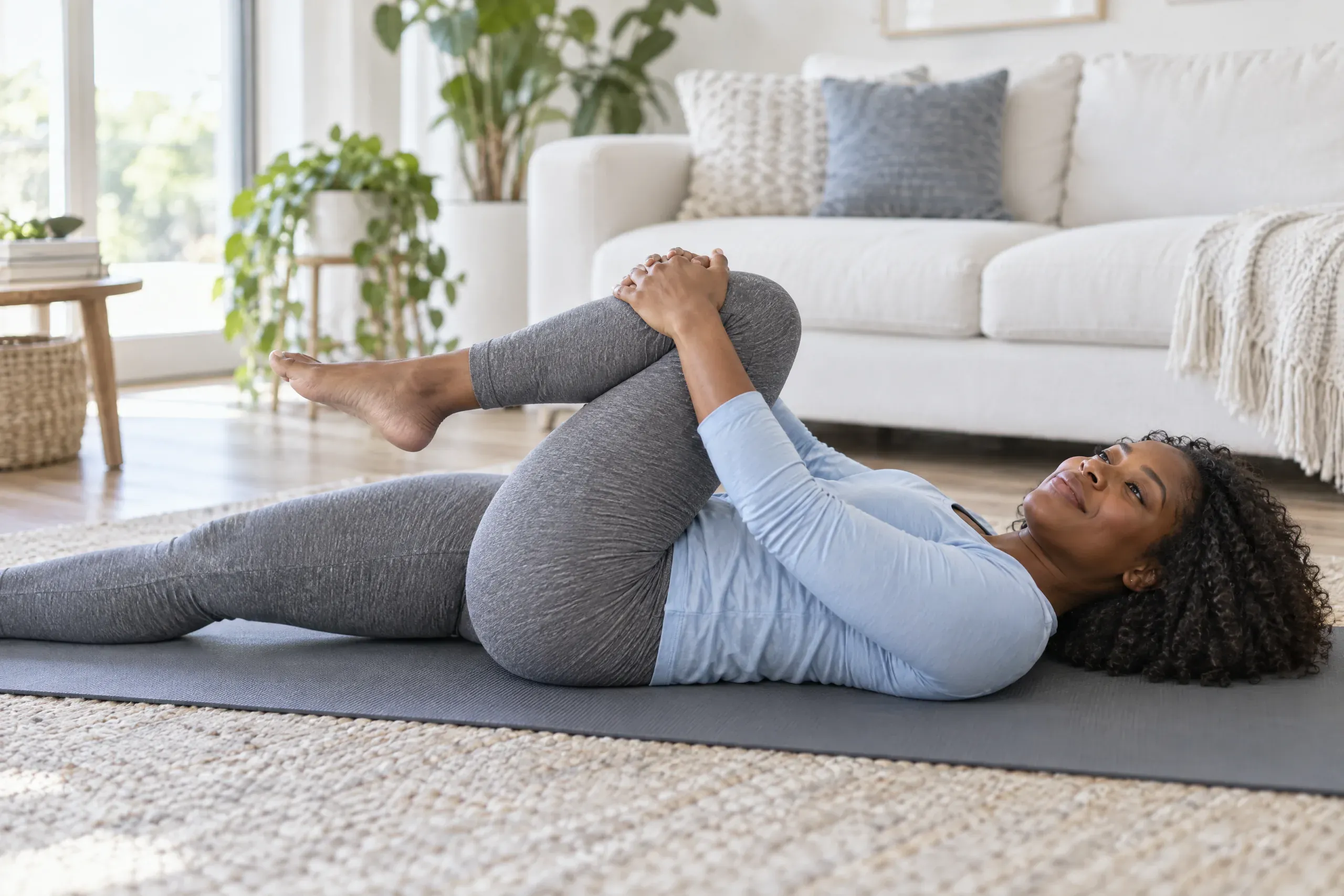
1. Knee-to-Chest Stretch
This classic stretch eases tension in the lower back muscles and the glutes.
- Lie on your back with both knees bent and feet flat on the floor.
- Bring one knee toward your chest, holding behind the thigh or just below the knee.
- Keep the other foot on the floor and your lower back relaxed.
- Hold for 20 to 30 seconds, then switch sides. Repeat 2 to 3 times per side.
If single-knee feels easy, you can bring both knees in together.
2. Cat-Cow
Cat-cow moves the spine gently through flexion and extension, which may reduce morning stiffness.
- Start on your hands and knees, with hands under shoulders and knees under hips.
- Breathe in as you let your belly lower and lift your chest and tailbone slightly (cow).
- Breathe out as you round your back toward the ceiling and tuck your chin (cat).
- Move slowly between the two positions for 8 to 10 repetitions.
Keep the range small if either direction is uncomfortable.
3. Piriformis Stretch
The piriformis is a small muscle deep in the buttock. When it is tight, it can contribute to buttock and lower back discomfort, and sometimes irritates the sciatic nerve nearby.
- Lie on your back with both knees bent.
- Cross your right ankle over your left knee, making a figure-four shape.
- Hold behind your left thigh and gently pull it toward your chest until you feel a stretch in the right buttock.
- Hold for 20 to 30 seconds, then switch sides. Repeat 2 to 3 times per side.
4. Child's Pose
Child's pose lengthens the muscles along the spine and offers a restful position between more active stretches.
- Kneel on the floor and sit back toward your heels.
- Walk your hands forward and lower your chest toward the floor, letting your forehead rest on the mat or a pillow.
- Breathe slowly into your lower back and sides.
- Hold for 20 to 30 seconds and repeat 2 to 3 times.
5. Pelvic Tilt
The pelvic tilt is a gentle way to wake up the deep abdominal muscles that support your lower back.
- Lie on your back with knees bent and feet flat.
- Tighten your stomach muscles and press your lower back softly into the floor, tilting your pelvis slightly upward.
- Hold for 5 to 10 seconds while breathing normally, then relax.
- Repeat 8 to 12 times.
How Often Should You Do Lower Back Stretches?
For most people, a short routine once or twice a day works well. Many find that stretching in the morning helps with stiffness after sleep, while an evening session helps unwind after a day of sitting or physical work. Consistency usually matters more than intensity: ten minutes most days tends to help more than an hour once a week.
Pay attention to how your back responds over the next 24 hours. Mild tightness that fades is normal as tissues adapt. Pain that lingers, spreads or gets sharper is a sign to scale back or check in with a professional.
Daily Habits That Protect Your Back
Stretching works best alongside everyday habits that keep the lower back from being overloaded in the first place. The American Chiropractic Association's patient resource offers helpful guidance on back pain self-care and prevention. A few simple changes can make a real difference:
- Break up sitting. Stand, walk or stretch for a minute or two every 30 to 45 minutes.
- Lift with your legs. Bend at the hips and knees, keep the load close and avoid twisting while you carry it.
- Stay active. Walking is one of the easiest ways to keep the spine moving and the muscles around it working.
- Set up your workspace. Keep your screen at eye level, feet flat on the floor and a small cushion behind your lower back if needed.
- Support your sleep. Side sleepers may feel better with a pillow between the knees, and back sleepers with a pillow under the knees. Our article on the best sleeping position for neck pain covers more on pillows and posture at night.
- Build core strength gradually. Gentle exercises like the pelvic tilt are a good foundation before adding harder movements.
When Stretching Is Not Enough: Professional Care
Home stretches can ease everyday stiffness, but they cannot tell you why your back hurts. If pain lasts longer than a few weeks, keeps coming back or travels into your buttock or leg, it may be time for an evaluation. Pain that radiates down the leg can be linked to sciatica or a herniated disc, and those conditions usually need more than stretching alone.
At Worthington Chiropractic, Dr. Jared Worthington starts with a consultation, a full chiropractic exam and on-site X-rays when needed to understand what is driving your symptoms. Depending on what he finds, a plan may include chiropractic adjustments in Bartlett, TN to restore joint motion, soft tissue therapy for tight muscles, or rehabilitation exercises that build on the stretches you already do at home. For disc-related pain, some patients are candidates for spinal decompression therapy in Bartlett, TN on the Triton 6M table.
You can read more about how we approach back pain treatment in Bartlett, TN, or meet Dr. Jared Worthington, DC before your visit.
Frequently Asked Questions
What stretches help lower back pain?
Knee-to-chest, cat-cow, the piriformis stretch, child's pose and pelvic tilts are among the most helpful stretches for lower back pain. They gently loosen the muscles around the spine and hips without forcing the joints. Hold each stretch for 20 to 30 seconds, move slowly and stop any movement that causes sharp or spreading pain.
How often should you stretch a sore back?
Most people do well stretching once or twice a day for about 10 minutes. Short, regular sessions tend to help more than long, occasional ones. Start with fewer repetitions and shorter holds, then build up over one to two weeks as your back tolerates the routine and stiffness begins to ease.
Is it safe to stretch with back pain?
Gentle stretching is generally safe for common, mechanical back pain. It should create mild tension, not sharp pain. Avoid stretching and seek care promptly if you have numbness in the groin, bladder or bowel changes, leg weakness, fever or pain after a significant injury, since these can signal a more serious problem.
When should you see a chiropractor for back pain?
Consider seeing a chiropractor if back pain lasts more than two to three weeks, keeps returning or radiates into your buttock or leg. An exam can help identify the source of the pain. At Worthington Chiropractic, walk-ins are welcome.
Can stretching fix a herniated disc?
Stretching alone usually does not fix a herniated disc, but certain gentle movements may ease symptoms for some people. Other stretches, especially deep forward bends, can make disc pain worse. Because every disc injury is different, it is best to have an evaluation first. Learn more on our herniated disc page.
What should you avoid with lower back pain?
Avoid heavy lifting, twisting under load, long periods of sitting and bed rest that lasts more than a day or two. Skip toe touches with locked knees and any stretch that sends pain down a leg. Staying gently active, with walking and easy stretches, is usually better than staying still.
Book a Back Pain Evaluation in Bartlett, TN
If stretches for lower back pain are not giving you the relief you need, we are here to help. Your first visit includes a consultation, full chiropractic exam, X-rays if needed and your first adjustment. Worthington Chiropractic is open Monday through Friday, 8 AM to 6 PM, at 7174 Stage Rd, Suite 111, Bartlett, TN 38133, and walk-ins are welcome. Book an appointment online or call (901) 519-7777.